
August 5, 2026
Strategy without execution is just intent: Dr. Kathryn Ritchie on HR Future Live
Listen to the episode
HR Future Live · Episode 84
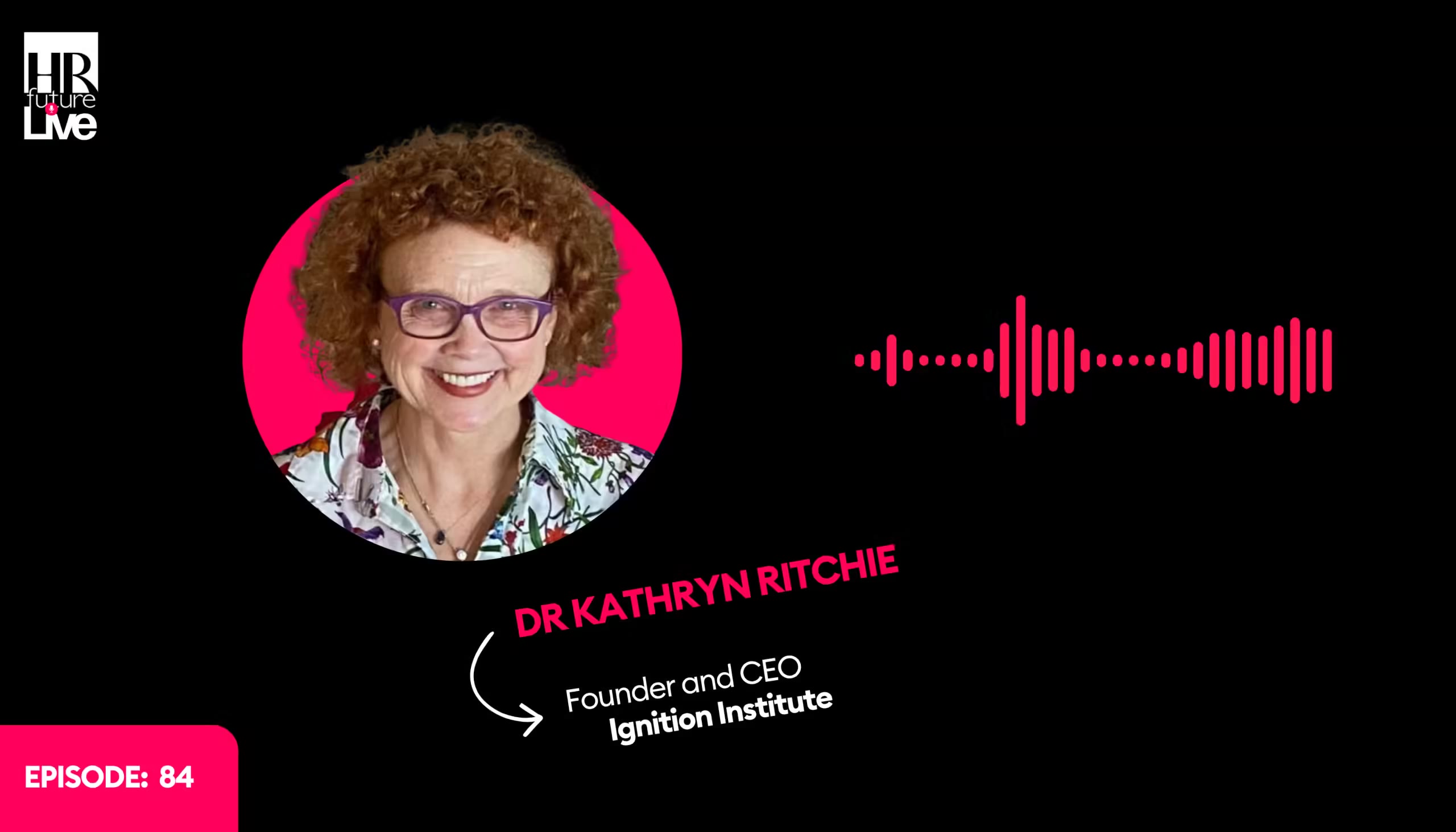
Dr. Kathryn Ritchie joined HR Future Live for Episode 84, “Strategy without execution is just intent: What HR leaders must do to turn vision into results.” Listen to the full episode and read the original article at HR Future.
Many organisations invest months refining strategy, commissioning research and presenting polished board papers, only to find that very little changes once the plans reach the wider business. The problem is rarely a lack of ambition. More often, it is the inability to translate strategy into coordinated action.
For CHROs, this presents both a challenge and an opportunity. As organisations navigate AI, economic uncertainty and changing workforce expectations, HR is uniquely positioned to bridge the gap between strategic intent and organisational execution.
According to Dr Kathryn Ritchie of Ignition Institute, successful organisations are not distinguished by having better strategy documents. They succeed because they create the conditions for people, leaders and culture to work in alignment behind a shared direction.
The missing link between strategy and execution
Many leadership teams develop a clear competitive strategy before communicating it across the organisation and asking departments to create their own plans. While logical, this approach often creates disconnects.
Each function interprets the strategy through its own priorities, resulting in competing initiatives, duplicated effort and fragmented execution.
Instead, organisations need the “middle ground”. This is a shared organisational plan that sits between high-level strategy and departmental objectives.
This middle ground establishes:
- A small number of strategic priorities
- A clear picture of future success
- Enterprise-wide initiatives
- Cross-functional dependencies
- Resource priorities
- Lead indicators that measure progress before financial results appear
Only once this shared roadmap exists should departments develop their own operational plans.
For CHROs, this means facilitating alignment across business functions rather than simply cascading communications.
Why alignment is now an HR capability
As businesses become more interconnected, execution depends less on individual departments performing well and more on collaboration across the enterprise.
Talent, technology, operations, finance and customer experience are increasingly dependent on one another.
This places HR at the centre of organisational effectiveness.
CHROs can strengthen execution by:
- Ensuring leadership teams share a common understanding of strategic priorities.
- Designing performance measures that reinforce enterprise goals rather than departmental success.
- Identifying capability gaps before execution begins.
- Building governance structures that encourage collaboration instead of competition.
When everyone understands not only what the organisation is trying to achieve but also how their work contributes, execution becomes significantly more effective.
Culture is more than engagement
Culture is often discussed as though it exists separately from business performance.
Dr Ritchie argues the opposite.
Culture is the outcome of every organisational decision, including governance, communication, leadership behaviour, organisational structure, performance management and resource allocation.
Employee engagement surveys provide valuable insight into how people feel, but they do not necessarily reveal whether the organisation is creating the conditions for sustained high performance.
For CHROs, this raises an important question.
Are you measuring employee sentiment, or are you measuring whether your organisation is designed to help people perform at their best?
Strong cultures do not emerge through values posters or awareness campaigns. They are reinforced every day through leadership decisions, organisational systems and consistent behaviours.
Leaders must become systems thinkers
One of the strongest themes emerging from Dr Ritchie’s work is the importance of systems thinking.
Organisations no longer operate in stable environments where leaders can optimise individual functions independently.
AI, geopolitical change, shifting customer expectations and economic volatility mean leaders must recognise how every part of the business influences every other part.
Rather than trying to control every outcome, leaders need to identify patterns.
Where are bottlenecks emerging?
Which teams are enabling progress?
Where are resources misaligned?
What external changes require a strategic adjustment?
For HR leaders, this requires developing organisational capability beyond traditional people management. Future-focused HR functions will increasingly use workforce analytics, organisational network analysis and predictive insights to identify emerging issues before they become performance problems.
The leadership behaviours that matter most
Technical expertise remains important, but execution increasingly depends on how leaders think.
Dr Ritchie highlights several behaviours that distinguish effective leadership teams:
- Genuine curiosity rather than certainty.
- Listening before providing answers.
- Asking better questions.
- Remaining comfortable with ambiguity.
- Encouraging robust discussion rather than seeking consensus too quickly.
High-performing boards and executive teams do not avoid difficult conversations.
They create environments where diverse perspectives strengthen decision making.
For CHROs, this means building leadership development programmes that strengthen judgement, critical thinking and collaborative problem solving, rather than focusing only on traditional management competencies.
AI cannot replace strategic judgement
Artificial intelligence is already transforming how organisations gather information and analyse markets.
It can accelerate research, challenge assumptions and generate alternative scenarios in seconds.
However, strategy remains fundamentally human.
AI can identify patterns and provide options, but leaders must still interpret context, balance competing priorities and make decisions that align with organisational purpose.
For HR leaders, this reinforces the importance of developing uniquely human capabilities, including judgement, adaptability, ethical leadership and influence.
The organisations that gain the greatest advantage from AI will be those whose people know how to ask better questions, challenge assumptions and make thoughtful decisions.
Practical actions for CHROs
To strengthen strategy execution across your organisation:
- Build an enterprise-wide execution plan before departments develop individual objectives.
- Align performance management with strategic priorities rather than functional targets.
- Measure organisational culture as a performance system, not simply through engagement surveys.
- Develop leaders who can recognise patterns, manage complexity and navigate uncertainty.
- Encourage executive teams to create space for constructive challenge instead of rushing to agreement.
- Ensure every major initiative directly supports strategic priorities, reducing competing projects and unnecessary complexity.
When strategy, leadership and culture reinforce one another, organisations become far more capable of adapting to change while maintaining focus on long-term success.
Dr Kathryn Ritchie is the Founder and CEO of Ignition Institute, a global strategy execution consultancy that helps organisations translate competitive strategy into measurable business performance. She is the author of Ignition: The Art and Science of Strategy and advises executive leadership teams across North America, Australia and Asia on strategy execution, organisational alignment, leadership and culture. Originally published by HR Future, August 2026.