

An interview with Dina Aletras

Originally published on Authority Magazine
Aspart of our series called “Five Things You Need To Be A Highly Effective C-Suite Executive,” we had the pleasure of interviewing Kathryn Ritchie.
Dr. Kathryn Ritchie, author of Ignition: The Art & Science of Strategy, is the founder and CEO of Ignition Institute, a global strategy execution firm that helps organizations align, scale, and thrive. With more than two decades of experience, Ritchie is a trusted advisor to leaders across North America, Australia, and Asia. She holds an MBA and an honorary doctorate and was named one of Women Leader Magazine’s Most Inspiring Leaders of 2022. Ritchie is an accomplished speaker, advisor, and advocate for strategic clarity and collective accountability.
Thank you so much for joining us in this interview series. Before we dive into our discussion, our readers would love to “get to know you” a bit better. Can you share with us the backstory about what brought you to your specific career path?
Little girls don’t dream of being a strategy execution consultant but along the path, some individuals discover they possess a “certain set of skills” that naturally align disparate viewpoints, embed capabilities to accelerate people and teams, and effortlessly gaze into chaos to facilitate the definition of clarity. So, here I am, and I genuinely can’t imagine doing anything else. Avocado toast chef was just not in my cards, I suppose.
My career has been an unusual tapestry. I started as a speech pathologist, working primarily with clients who had experienced neurological lesions — head injuries, strokes, neurological degeneration. That work taught me something fundamental: when a human being has a clear goal and the right conditions to pursue it, the results can be extraordinary. The importance of an owned goal, clean two-way feedback, a solid plan, and a willingness to test and learn — these were lessons I absorbed early, and they have never left me.
From there, I moved into running a rehabilitation center in central Sydney, focused on neurological and physical trauma. I was appointed managing director at 28 — the youngest professional on a team of experienced paramedical and medical specialists who, frankly, did not want a young woman leading them. I spent those first months in near-unchosen isolation. I had to earn the right to lead. I had to ask, listen, and learn. That period shaped the principles I carry into every boardroom today — starting with humility.
The pivot to strategy consulting happened when a client asked me to run a leadership strategy session. When I asked why he thought I was the right person, he said: “You have an instinctive sense of business, a deep understanding of human beings because of your background in speech pathology, and you are disciplined. I know you’ll drive outcomes whether I pay you or not.”
That conversation became the foundation of my entire model. I have been at it for over 30 years, and the opportunity to help leaders and organizations ignite and unleash their potential still fires me up every single day.
The thesis that has developed over decades of research and development in the space comes down to three well-defined principles of guidance.
- Strategy only lives if it shapes decisions and behavior every day.
- Without an aligned performance operating system, strategy cannot be executed optimally.
- Execution lives or dies in the Middle Ground™
Can you share the most interesting story that happened to you since you started your career?
There are so many, but one stands out — and it happened quite recently, in an unexpected place.
I completed the Angels Landing hike in Zion National Park in Utah. For those who don’t know, that is considered one of the five most dangerous hikes in North America. I didn’t know that going in. My daughter assured me I’d be fine. She was, shall we say, optimistic.
The near-mile ascent to the pinnacle along a narrow, rocky ridge — with sheer drop-offs of almost 1,500 feet on either side — was one of the most terrifying experiences of my life. There was a chain for part of it. And then there wasn’t. I was walking alone, feeling genuinely sick with fear, and absolutely determined to finish.
What happened on that ridge is something I will never forget. Strangers rallied around me. People I had never met and would never see again offered encouragement, steadied my nerve, and helped me navigate the hardest stretches. Support was palpable and real — the very best of humanity showing up on a mountain in the Utah desert.
I didn’t realize until afterward that this was a profound metaphor for strategy. It takes real courage to make the choices that matter, to leap from the place you know and most trust to one you need to test for your organization to progress and thrive in this rapidly changing world. You won’t have certainty of the outcomes and yet if you don’t take the step, the risk of staying is likely to be the greater risk. It is hard to stay the course when you can’t see clearly ahead, and to trust that the right people will show up to help you through the hard parts. That hike taught me something about my own resilience that I had never quite articulated before. And it gave me the push I needed to finally finish my book.
Can you please give us your favorite “Life Lesson Quote”? Do you have a story about how that was relevant in your life?
There are two and I can’t separate them.
The first is from Reading the Room by David Kantor: “A leader falls short of greatness without great skill in face-to-face talk.” I studied Kantor’s work on structural dynamics of face-to-face communication over a decade ago. It was a transformational experience for me. In his book Reading the Room, he brings his theory into practice largely through a case study of a leadership team. I see this work as an essential part of a leader’s toolkit. As the leader, you need to be able to influence the efficacy of the dialogue from the inside of the conversation without controlling it, distorting it, or shutting it down. I would add that we show our best and our worst in conversations. The more self-aware we are and the more skilled we are in our participation in conversations, the more valuable is our impact. Leadership teams that are able to have real and powerful conversations have a substantial advantage.
A second quote that I came across quite recently gave weight to what my instinct had told me for years. It comes from Adam Grant’s book Originals: “When it comes to idea generation, quantity is the most predictable path to quality.”
I think about this constantly — in my own life and in my work with leaders and their organizations. We are conditioned to want to solve and conclude as fast as possible. Presenting polished answers, and avoiding the mess of not knowing is reinforced on every front. But great strategy — and great leadership — is born in exactly that messy space. Einstein wrote more than 200 papers that had little impact while developing his theory of relativity. Edison filed well over 100 patents for inventions that went nowhere. The breakthroughs came because they kept generating, kept exploring, kept refusing to let certainty cut off possibility.
The other common cry from leaders that serves as a force against the principle of “more options the better at the outset” is, we have too much on and we need to prioritize. And this may well be the case. Too frequently, their antidote to this problem is to limit the options, ideas, or possibilities. This is exactly the opposite of what Grant is advocating. The main reason that organizations struggle to prioritize is they are not clear enough about their strategy and how it translates into executable form. They attempt to make the inevitable tradeoff decisions at the wrong altitude, at either the conceptual or at the micro level. This is a different challenge altogether.
The most dangerous thing I see in organizations is the norming away of disagreement and uncertainty. We have almost made it wrong to say, “I don’t know” or “I don’t agree,” and this is particularly evident at the most senior levels — C-teams and Boards — the very leaders who most need honest challenge and diverse perspective. This costs organizations enormously.
Grant’s quote reminds me to stay curious, to resist the seduction of the tidy answer, and to keep pushing myself and the people I work with to explore more options before locking in a direction. Quality really does come from quantity — of ideas, of questions, of perspectives and thoughtful interrogation. Data, data, data — we cannot make bricks without clay. Having the courage to walk along the path of uncertainty will allow time for assessing the options. And by the way, this process doesn’t need to be either slow or inefficient.
Is there a particular book that made a significant impact on your leadership style? Can you share a story or an example of that?
Many books have shaped my thinking in relation to the space I work in. I will call out two — one from the 1990s and one from 2024. I continually return to them both.
The first is from Beyond the Boundaries by Dexter Dunphy, Emeritus Professor, one of my lecturers and more recently a mentor, and Doug Stace. This book covers strategy execution and brings in many aspects of what makes for good strategy. But more particularly, it discusses the intersection of strategy execution, including change, culture and the importance strategy and execution being seen through the lens of systems thinking along with implications for leaders. The authors blend theory and practice superbly and the principles are as relevant today as they were 30-plus years ago when it was written. The book is ostensibly about organizational change and transformation as they relate to strategy execution. Much struck me when I first read this book; however, one thing stood out. Change, no matter the scale, only has meaning if it is connected in the heart of the strategy. There is always a strategic change agenda embedded in every plan that drives strategy execution. Too often, it is distilled into a disconnected change agenda. Without direct connection with the strategy, any change — and that includes transformational programs of work — risks being seen as change for change’s sake. This weakens their impact, and we still sit with a suboptimal/failure rate of about 70% of all project execution, and strategy execution is simply a collection of projects.
The second book is Uncertain: The Wisdom and Wonder of Being Unsure by Maggie Jackson. She articulates something that is central to how I think about strategy and leadership: that our brains are most activated when facing uncertainty. When we let go of control and sit with not knowing, we position ourselves to move beyond our known world. That is where learning happens. That is where great strategy is seeded. We need to override so many norms to sit in this important space of ambiguity. And it feels so uncomfortable.
Both books reinforce the same fundamental truth: uncertainty is not a problem to be eliminated. It is the very condition in which possibility lives.
What do you think makes your company stand out? Can you share a story?
Ignition Institute stands out because we connect things that are too often treated as separate: competitive strategy, execution, culture, leadership, people, and governance. We are not a strategy boutique. We are not an organizational development firm. We are not a change management consultancy. We are all of these things, working together, because that is how organizational performance actually works. Silos are the enemy. The disconnected world is a labyrinth of ignorance, mistakes, and missed opportunities. Take medicine — without integrated teams of professionals and carers, people die. Show me a silo, and I’ll show you a guaranteed opportunity for drastic performance improvement.
Most of our competitors operate in one lane. We work in the space in between — what I call the Middle Ground™ — where strategy meets execution and where the gap between intent and outcome is either closed or widened.
A story that captures this well: I was brought into an organization after a new CEO had been appointed. The leadership team had been through multiple strategy sessions with well-regarded consultants. There were polished presentations and signed-off plans. And yet, when we got into the room together and really examined what was driving the business, the CEO looked at me and said, “We are where we are because of a series of disconnected decisions. I don’t think there is a real strategy any longer. We have to start again.”
That was a confronting moment — and a freeing one. We built from that honesty. And what distinguished our work wasn’t just the strategy we developed together, but the activation of the entire system: starting with the leaders in that strategy, the people more broadly, the culture, the governance rhythm, the capability of leaders to tell and live the story every single day. That is where Ignition Institute operates. That is our difference.
You are a successful business leader. Which five character traits do you think were most instrumental to your success? Can you share a story or example for each?
Firstly, I am a voracious learner. Even though I talk a lot, I am an external processor, I am listening and pattern reading all the time. This sparks continual curiosity and courage. This has always been with me and drives so many other characteristics like my ease with change.
This brings me to the second, which is comfort with uncertainty. I grew up attending four schools by the time I was 12 years old — moving from a country town in New Zealand, where we played Māori poi dances and stick games, to a strict English-style boarding school at 9, and then into an Australian high school at 12. Having to learn and adjust to entirely new environments repeatedly meant that uncertainty and change became second nature to me. What I can also say is that it didn’t always feel great and I simply had to build that toolkit. In strategy, this is essential. You cannot develop a genuinely strong competitive position if you are always reaching for the certain, the controlled, the already-known. Sitting in the discomfort of not knowing yet is where the real answers live.
The third is humility. When I was appointed MD of the rehabilitation center at 28, most of the team did not want me there. I spent months in near-isolation. I could have pushed harder, asserted authority I hadn’t yet earned. Instead, I asked questions. I listened. I found mentors. The lessons from that period became foundational to how I work with every leadership team I enter. Humility is not weakness — it is the fastest path to earning the right to lead.
There is a fourth, which is candor and transparency. I seek to bring both into everything I do, always with care for the human dimension involved. There are number of reasons why this is so important. The two most pertinent are: firstly, it is quite simply a waste of time and potentially very risky if leaders are dealing with anything other than real perspectives and observations. There is still the need to challenge and discuss the different views, and for this to be useful, we all need to bring our views to the table with candor, transparency, and respect. Following the meltdowns of major companies like Adelphia, Enron, and WorldCom, HBR published Sonnenfeld’s research findings. His article, “What Makes Great Boards Great”, argued that governance crises were not caused by corrupt or incompetent directors, but by boards failing to function as healthy social systems.
What distinguishes great boards, and this can be applied in any leadership context, is a social system based on trust and candor. I characterize this as having the right conversations, in a real way, with the right people, at the right time and usually fast. The second is that people, particularly through an organization, are very good at identifying insincerity and a lack of forthrightness. In fact, they are looking for dissonance and will test declared alignment. This lack of perceived congruence becomes an immediate barrier to people owning and executing on that strategy — immediate waste. I must hold myself to this same standard.
The fifth is discipline. My early colleague was right about this when he chose me for that first strategy session. I am relentless about follow-through. Strategy without execution is just a conversation. Discipline is what turns thinking into momentum, and momentum into results. The frameworks I have developed — the Ignition Method, the Middle Ground™, the Performance Operating System™ — are all built on this principle: that insight without a disciplined system to bring it to life is wasted potential.
Leadership often entails making difficult decisions or hard choices between two apparently good paths. Can you share a story with us about a hard decision or choice you had to make as a leader?
The hardest decision I have faced repeatedly — and it never gets easier — is choosing to tell a client the truth they don’t want to hear.
Early in my consulting career, I met a highly successful entrepreneur who had built a thriving business over many decades. When I asked him about what strategy conversations he had with his leadership team and whether key directional thinking was documented, he told me that such conversations would largely be a waste of time. He pointed to his company’s extraordinary and persistent performance as evidence that nothing needed to change.
I had a choice: validate his confidence, and clear success — take the easier path, or say what I genuinely believed. I told him that while he was in the building, things would be fine — he was the walking book of everything the organization knew about itself. The challenge would come when he stepped down. He was comfortable that his son would handle the transition. I was not.
Get Authority Magazine Editorial Staff’s stories in your inbox
Join Medium for free to get updates from this writer.Subscribe
Remember me for faster sign in
I monitored that business through the transition from the sidelines. It did not go smoothly. Enormous value was lost — value that could so easily have been preserved through a more deliberate handover of strategic knowledge and capability.
That experience reinforced something I carry into every client relationship: the most important thing I can offer a leader is not agreement. It is honest, constructive challenge, even when it is uncomfortable to deliver and unwelcome to receive. Choosing to speak the hard truth, delivered with care and respect, is both the most difficult and the most valuable thing a trusted advisor can do.
Most of our readers think they have a pretty good idea of what a C-Suite executive does. But in just a few words, can you explain what a C-Level executive does that is different from the responsibilities of other leaders?
A C-Suite executive is responsible for the system, not just a part of it. A leader’s role is fundamentally to create the conditions so their people can do their very best each day and grow. Every leader in an organization is accountable for performance within their domain. A C-Suite executive must see the whole — how the competitive strategy, the culture, the people, the governance structures, and the execution rhythm connect and reinforce one another. Or don’t. The CEO’s role, specifically, is to be the chief architect and guardian of competitive strategy. Not to delegate it. Not to approve it once a year and move on. To live it, translate it, hold the organization to it, and evolve it as the environment demands. Strategy is the first and most critical responsibility of the CEO and their leadership team. Everything else — the culture, the capability, the priorities, the structure — should flow from and serve that strategy. When it doesn’t, performance suffers, and it is the C-Suite’s job to recognize that and act. System-wide alignment is critical.
What are the “myths” that you would like to dispel about being a C-Suite executive? Can you explain what you mean?
The biggest myth is that being in the C-Suite means having the answers. The most effective leaders I have worked with are the ones who are most comfortable saying, “I don’t know,” and then be open to ideas and challenge. To genuinely seek different and diverse views without a predetermined answer they are seeking. This does not take away their decision rights. We have almost normalized the opposite — an expectation of certainty and confidence at the top that actually suppresses the very conversations that would make the organization stronger. Closely related to this is that C-Suite leaders are humans. Notwithstanding their likely talents, they too have frailties and uncertainties. The more they can embrace this through a balance of confidence and humility, the more effective they will be.
Great strategy is not the product of certainty. It is a consequence of not always knowing — of generating many options, testing, learning, and refining. The organizations that win over time are those whose leaders foster robust challenge and genuine inquiry, not those whose leaders perform confidence and demand agreement.
The second myth is that culture is the responsibility of HR. Culture is the direct output of every decision, action, and behavior a leader takes — what they prioritize, what they reward, what they tolerate, how they behave when things are hard, and the other policies and structures that result from their decisions. Through their actions and decisions, leaders set the tone for everything. The CEO’s decisions, actions, and behaviors have a disproportionate impact and can override policies and more if team members perceive this to be the pattern. Culture cannot be outsourced. It cannot be addressed through a program. It is shaped, day by day, in the choices leaders make.
And the third myth is that strategy is a document that needs to be approved. Strategy is a living, breathing hypothesis about how your organization will win in its market. It must be translated into executable form, embedded through the culture, and revisited continuously in a flywheel of testing, learning, iterating, and refining. When it becomes a PowerPoint deck that sits on a shelf between annual planning cycles, it is no longer a strategy. It is a relic — an expensive one.
What are the most common leadership mistakes you have seen C-Suite leaders make when they start leading a new team? What can be done to avoid those errors?
The most common mistake is assuming they must figure it out themselves, maybe with a sounding board or two. And I watch C-Suite leaders continue to do this. Yes, they hold the reins of their strategy, culture and execution. But they shouldn’t feel that everything is on them, and that they must do all of this on their own and then try to get buy-in and ownership from their team. They miss harnessing the collective intellect and tend to arrive, even if not spoken, with the answer. The most common mistake used to be moving too fast to assert direction before earning understanding. This is less so: C-Suite leaders know they have to be patient and listen. The opportunity lies in truly harnessing the intellect and diverse experiences of as many as possible and efficiently assessing and synthesizing.
This can be amplified when a new C-Suite leader arrives. The instinct — often well-intentioned and often in a first 100-day plan — is to demonstrate capability quickly. They know to observe and listen and still it is hard hold back. Observation and true listening are still quite rare outside of seasoned leaders. New leaders want to show they know what they’re doing; to make decisions, set priorities, and communicate change. But this speed frequently comes at the cost of listening. And the cost of not listening is enormous: you miss the sediments of knowledge that already exist in the organization — the instincts, insights, and intelligence that people carry but may not yet offer freely to someone they don’t yet trust.
The second common mistake is underestimating the founder’s footprint, particularly in entrepreneurial businesses. When a founder or long-standing CEO departs, there is typically a gaping space where their unconscious strategic instinct used to live. New leaders who don’t diagnose this gap can find themselves leading a team that is strong at executing instructions but has not been built to think and decide strategically. Understanding what was previously held in that person’s head — and making it explicit throughout the organization — is essential.
And third: assuming that a good strategy, once communicated, will be understood and owned. It won’t. People don’t internalize direction through a townhall presentation or four. They internalize it through conversation, through connection to their own role, through the story being told and retold in a way that makes it real. The most effective leaders I have seen invest enormous energy and time in creating the space for translating strategy through every level of the organization — not cascading it from the top. Rather, they bring it to life through circles of the conversation. That process undisputedly defines and shapes culture. This is part of what I call the Middle Ground.
In your experience, which aspect of running a company tends to be most underestimated? Can you explain or give an example?
Without question: the cost and complexity of translating strategy into execution.
Around 70% of projects and initiatives fail to deliver on their promises. This statistic has persisted for decades, across studies by Harvard, McKinsey, BCG, and others. And yet, in boardrooms and strategy sessions, this reality is rarely confronted directly. Leaders often know something hasn’t worked. They fear that acknowledging it will reflect poorly on their leadership. So the lessons go unlearned, and the same mistakes repeat.
The gap I see most consistently is again, the Middle Ground™ — the space between the high-level strategic thinking and the day-to-day operational activity. This is where strategy either comes to life or quietly dies. It requires identifying the bodies of work needed to deliver the strategy — structural, cultural, capability-related, process-related — and managing the trade-offs, sequencing, and prioritization that allow the whole organization to move in alignment.
Most organizations make a giant leap from conceptual strategic decisions to a list of activities and KPIs. On the surface, it looks accountable. In practice, the competitive teeth of the strategy have already been lost in translation.
This is compounded by the fact that the change embedded in the plan is not called out deliberately and is assumed. Change requires specific leadership. There is always a strategic change agenda associated with the plan that embodies the translation of strategy to action.
The leaders who close this gap — who invest the time, attention, and skill in the Middle Ground™ — are the ones whose strategies actually deliver.
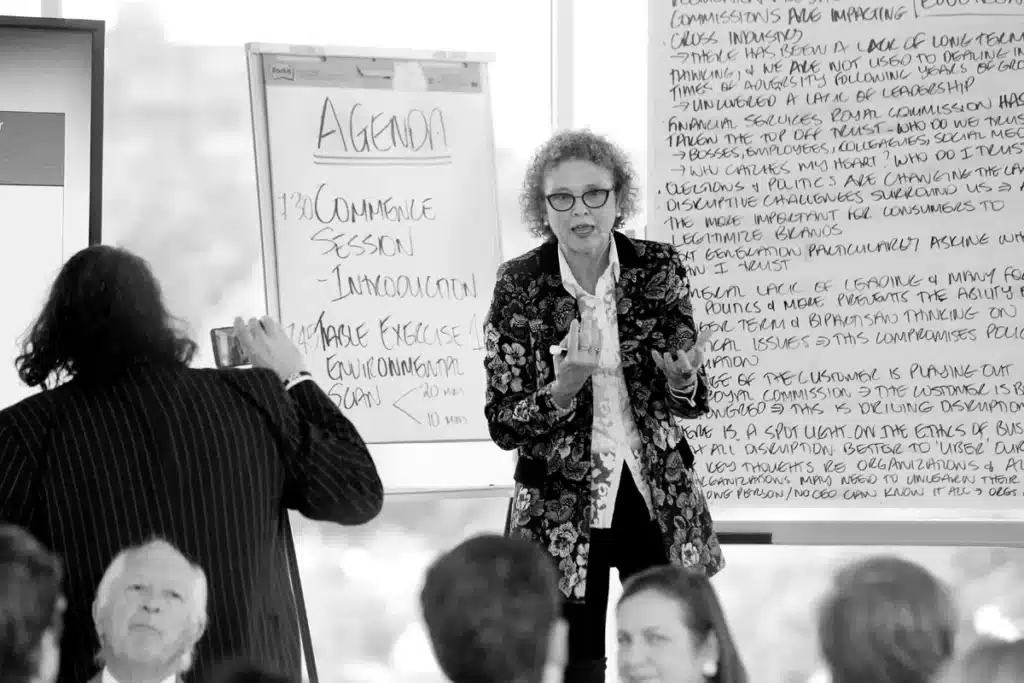
What are your “Five Things You Need To Be A Highly Effective C-Suite Executive”? Please share a story or an example for each.
1. Strategic Clarity
You must know, with genuine conviction, how your organization competes to win. Not a vision statement. Not a set of values. A real, testable, articulable answer to: what unique value do we create, for whom, and why would they choose us over every other option available to them? I have sat in too many strategy sessions where the “strategy” on the page bore little resemblance to the actual choices being made in the business. “The Emperor Has No Clothes,” as the story goes, and too few people around the table will say so. A highly effective C-Suite executive insists on real strategy, not a performative strategy.
2. Execution Discipline
Clarity without execution is just aspiration. The best leaders I have worked with understand that executing strategy is the hard part, and they build the systems, rhythms, and accountabilities to make it real. They invest in the Middle Ground™: the plan behind the plan, the governance forums, the cultural reinforcement, the measurement systems that keep the organization aligned and moving. They understand that around 70% of strategic initiatives fail, and they refuse to be part of that statistic. They are focused and keep learning.
3. Comfort with Uncertainty and Learning
The world moves too fast for a leader who needs certainty before acting. Effective C-Suite executives have the courage to explore, test, and adapt. They create the conditions for their organizations to do the same — shifting from a model of analyze-understand-execute to a flywheel of explore-test-learn-adapt. The organizations I see winning right now are not waiting for certainty. They are building capability through iteration.
4. Cultural Leadership
Culture is the immune system of an organization: it reinforces what fits and rejects what doesn’t. A highly effective C-Suite executive understands that culture is not an HR initiative. It is the direct output of every decision they make, every behavior they model, every accountability they hold or let slide. They know that even the best strategy will fail if the culture is misaligned with it. And they measure it — objectively, over time — because what you don’t measure, you cannot improve and you can’t adapt in an aligned way that will support the strategy.
5. The Courage to Challenge and Be Challenged
The most dangerous dynamic in a leadership team is false harmony. When the most senior leaders in a room are never genuinely challenged, and when challenge is implicitly discouraged, the organization loses its ability to adapt. Highly effective C-Suite executives actively cultivate the space for dissent. They surround themselves with people who will play devil’s advocate, who speak up, who question. They are as willing to be wrong as they are determined to be effective. That combination — conviction and openness — is rare. But it is what separates the truly great from the merely successful.
In your opinion, what are a few ways that executives can help to create a fantastic work culture? Can you share a story or an example?
Culture is shaped by what leaders do, not what they say. That is where I always start.
If you tell your team that strategic thinking is valued, but every meeting is about short-term numbers, the culture will learn to optimize for short-term numbers. If you say you value honesty and challenge, but visibly freeze when someone disagrees with you in front of the group, your team will learn to stay quiet. Culture reads actions, not intentions.
So the first and most powerful thing an executive can do to build a great culture is to model, consistently and visibly, the behaviors they want to see. Not occasionally. Not when it’s convenient. Every day, in small decisions and large ones. They need to understand what the conditions are that will support high performance. These have been researched and defined.
The second is to create genuine psychological safety — the conditions in which people can say, “I don’t know,” “I made a mistake,” or “I think we are wrong about this,” without fear of retribution. I mentioned the research earlier: we have almost normalized away from “I disagree” at the most senior levels of organizations, which is exactly where courageous challenge matters most. Particularly in such dynamic and unpredictable times.
And the third is to ensure the culture is anchored in strategy. Your culture should reinforce your competitive advantage. The way you think, decide, and operate should be distinctively aligned with how you win in the market. When culture and strategy are connected, each reinforces the other. When they are disconnected, even the best-designed strategy will leak energy at every turn.
A story that captures all three: I worked with one organization where a team member from operations — not a senior leader — gave the clearest, most compelling articulation of the company’s strategy I had heard in the whole engagement. They had internalized it completely. That happened because the leadership had created conditions where everyone’s voice mattered, where the strategy was told as a story people could make their own, and where the culture genuinely rewarded strategic thinking at every level.
You are a person of great influence. If you could start a movement that would bring the most amount of good to the most amount of people, what would that be?
I would start a movement to rebuild our collective relationship with curiosity, exploration, and uncertainty — and, through that, with genuine learning. Education has been ignored for far too long — certainly in the United States. The curiosity of a child must be encouraged and fed a rich diet of fuel that will spark and sustain the flame of lifelong learning.
We have engineered so much of modern organizational life to resist and resolve uncertainty as quickly as possible. We reward certainty. We penalize not knowing. We design processes to eliminate ambiguity. And in doing so, we have closed off the very conditions in which the most important thinking, innovation, and growth occur.
The space of the uncertain is where learning and innovation live. When we sit with not knowing — when we resist the urge to force a premature answer and instead explore what might be possible — we position ourselves to move beyond our known world. That is true for organizations. It is equally true for individuals, communities, and societies.
My movement would create permission, at every level — in schools, in workplaces, in leadership teams — to say, “I don’t know yet,” to ask more questions than we answer, to look out beyond that which we know and imagine, dream and play, to let go of tight goals and yet keep them, test before we conclude, and to learn from what doesn’t work as vigorously as we celebrate what does.
The organizations that are winning today are those that have learned to learn. The leaders who endure are those who can sit in the messy middle of figuring it out without losing their nerve. That capacity — to be uncertain and still act with purpose — may be the most important human skill of the era we are in. And I would love to see it celebrated rather than hidden.
How can our readers further follow you online?
You can find me and the work of Ignition Institute at ignition.institute. I am also active on LinkedIn, where I regularly share my thinking on strategy, leadership, and execution. My book, Ignition: The Art & Science of Strategy, is available everywhere in May this year. I would love to stay connected with anyone who is wrestling with the challenges we have discussed today — that is where the most interesting conversations begin.
Thank you for sharing these insights!
About the Interviewer: Dina Aletras boasts over 20 years of expertise in the corporate media industry. She possesses an in-depth understanding of growth, strategy, and leadership, having held significant roles at some of the UK’s largest media organizations. At Reach PLC, the UK’s largest tabloid publisher, she served in various director capacities. Additionally, she held leadership roles at The Independent Magazine Group and DMGT. Her extensive knowledge spans editorial, digital, revenue, sales, and advertising.
Upon relocating to Switzerland, Dina took on the responsibility of managing and promoting the international section of Corriere del Ticino — CdT.ch pioneering the English page “onthespot.” She also was the Co-Editor of Southern Switzerland’s first official Italian and English bilingual magazine.